
Yacht Maintenance Software with Planned Maintenance by Engine Hours
HelmOps is yacht planned maintenance software built around engine hours. Crew enter readings from each hour meter, every service records its running-hours interval, and the job turns due soon and then overdue as the engines run. Calendar-based jobs and certificate expiry reminders sit in the same plan.
What it looks like in HelmOps
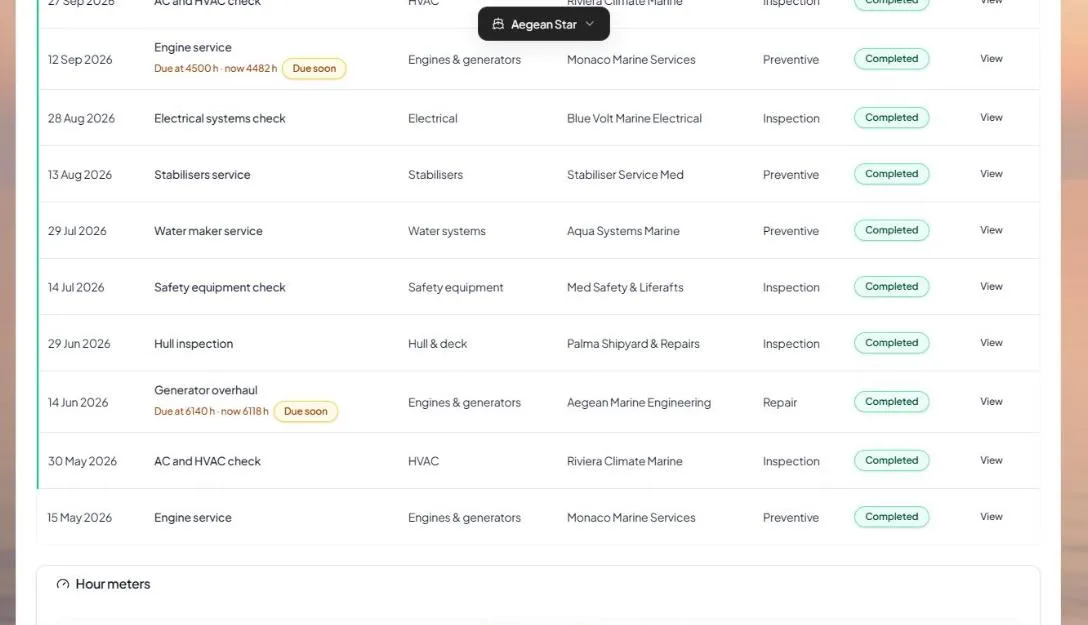
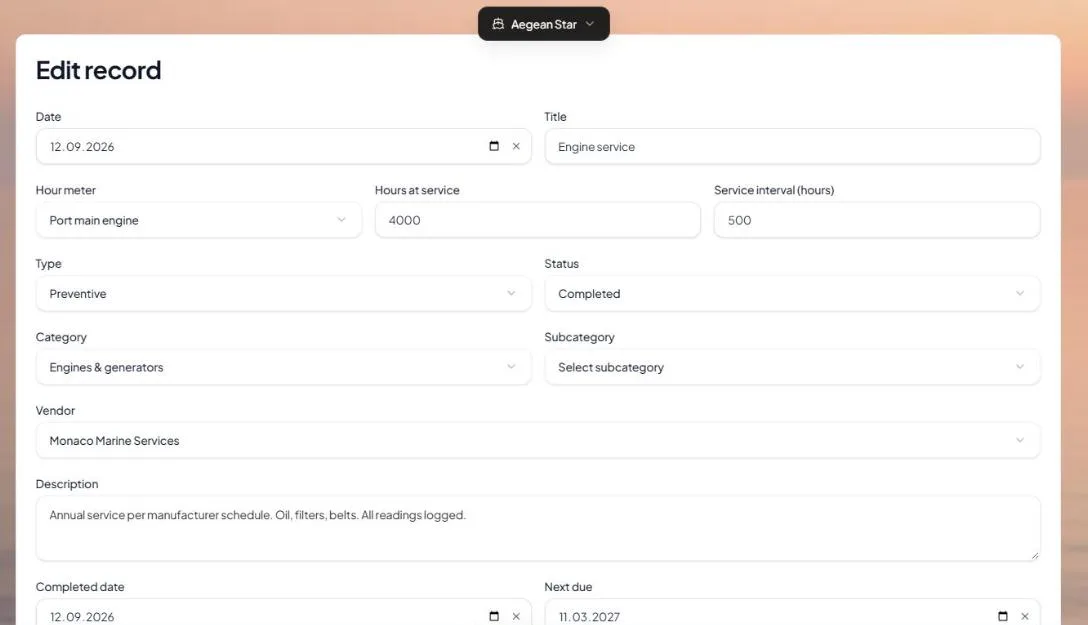
Planned maintenance by engine hours, driven by hour meter readings
Set up a named hour meter for each piece of equipment that runs on hours, such as port and starboard mains, generators, a tender engine or a watermaker, and the crew enter readings as they take them. A reading can only move a meter forward, so a typo cannot quietly roll the hours back, and every reading is stored with who entered it and when. When an engineer logs a service against a meter, HelmOps stores the hours at service and the running-hours interval and works out the hour at which the next service falls due. Each new reading is checked against that figure: the job turns due soon when the meter comes within 10% of the interval or 25 hours of it, whichever is larger, and overdue once the meter reaches the due hour. The owner and captain get an in-app notification and a push alert at each change, and logging the same service again on the same meter retires the older reminder instead of repeating it.
Calendar intervals, certificates and survey documents in the same plan
Not every job runs on hours. Calendar-based work such as annual liferaft servicing, fire-system checks or hull inspections carries a next due date, shows on the maintenance calendar, and triggers reminders 90, 60 and 30 days before it falls due. Vessel certificates and survey documents stored in the document vault with an expiry date get the same 90, 60 and 30-day reminders, so the captain sees statutory deadlines beside the technical work instead of in a separate spreadsheet. Routines that are better run as crew tasks, such as weekly engine-room rounds, can come from recurring task templates set to the maintenance type.
A maintenance history that stands up to a survey, a sale or a handover
Each record carries its type (preventive, repair, inspection, upgrade or emergency), status, component, category and subcategory, vendor or service provider, labour hours, warranty and warranty expiry, notes, and attached photos, invoices and service reports. Engineers can filter the history by date, category, vendor, status and type, and move records in and out as CSV, so bringing in an existing spreadsheet log is a one-off import rather than a retyping job. The result is a record a surveyor, buyer, insurer or relief engineer can read without asking the crew to reconstruct it.
Built for logging at sea, without a signal
Maintenance is often logged in the engine room or at anchor with no coverage. In the HelmOps iOS app and on the web, a new maintenance entry and its photos are saved on the device when the connection drops and delivered automatically when it returns, so nothing has to be retyped from memory. Hour meter readings need a connection to save. The app runs in English and Turkish.
Engine service schedules
Free 250 to 2000-hour planning checklists for common yacht engines. Each one can be set up as an hour meter plan in HelmOps.
Engine running-hours log
Log meter readings for each engine, see the hours between entries and track hour-based services. A service turns amber with 50 hours or less to go and red when it is due.
Frequently Asked Questions
Try it on your own boat
Every plan includes all features. Start your 30-day free trial without a credit card.