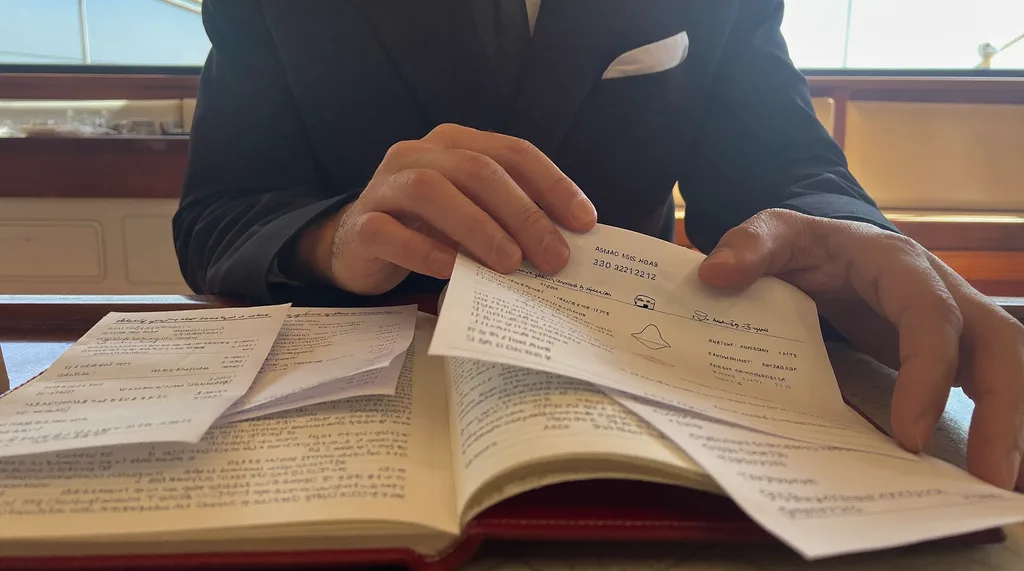
The APA reconciliation is usually the last conversation of a charter — presented on the final morning, after a week of good service, good weather, and a relationship the captain has spent seven days building. It is also, disproportionately, where that relationship can go wrong.
Our guide to managing APA covers what the allowance is and how to run the account day to day. This one is about the moment prevention fails: a charterer looks at the final numbers and does not agree with them. What happens next determines whether the season ends with a repeat booking or a broker fielding a complaint.
Sources: MYBA Charter Agreement standard terms; charter industry cost and dispute-resolution analysis, 2025–2026.
Why APA Disputes Happen
An APA dispute is rarely about a single large number. It is almost always about a gap between what the charterer expected and what the reconciliation shows — and that gap has a small number of recurring causes.
Undocumented expenditure. This is the dominant trigger, by a wide margin. A line item with no receipt, invoice, or supporting record gives the charterer nothing to verify it against. It does not matter whether the spending was entirely legitimate — an unreceipted item is, by definition, disputable, and the burden falls on the captain to prove it after the fact rather than having proven it at the time.
Provisioning surplus or shortfall. A well-run charter often ends with either unspent provisioning budget or a modest overage once the final grocery run and last-night dinner are accounted for. This is a normal reconciliation line, not inherently a dispute — but if the captain has not been reporting a running balance throughout the trip, the final number can look like a surprise even when it is legitimate.
Currency conversion. On itineraries that cross currency zones — a Mediterranean route touching euro-zone ports and Turkish or Croatian waters, for example — APA is typically collected in euros or US dollars but spent in local currency at each stop. A reconciliation that does not clearly show the conversion methodology and rate used for each expense invites the charterer to ask, reasonably, how the final total was calculated.
Last-day and disembarkation costs. Fuel top-ups, final cleaning, and disembarkation logistics often land in the final 24 hours of a charter, close to when the reconciliation is presented. Costs that arrive at the very end, with little time to explain them before the charterer departs, are more likely to feel like an afterthought than a legitimate part of the trip's running costs — even when they clearly are.
None of these triggers require bad faith on anyone's part. A captain running a clean, receipted operation and a charterer asking reasonable questions about an unfamiliar accounting process is the normal case, not the exception. The goal of dispute prevention is not to avoid difficult charterers — it is to remove the ambiguity that turns a normal question into an actual dispute.
Prevention: The Documentation Standard
The single most effective dispute-prevention practice is disciplined, contemporaneous documentation. Not documentation reconstructed after the fact — documentation captured at the moment of spending.
Photograph or scan every receipt at the point of purchase. A herb purchase at a local market and a five-figure bunkering stop get the same treatment: captured immediately, not remembered later. Retrospective reconstruction of a week's spending is where gaps and errors creep in.
Categorise as you go. Fuel, provisioning, port fees, transfers, activities — assign the category at the time of entry, not in a batch session the night before the final report is due.
Report a running balance during the charter, not just at the end. A brief update every one to two days — even a simple running total — means the final reconciliation contains no numbers the charterer has not already seen building up. This single habit eliminates most of the "surprise bill" feeling that turns a legitimate expense into a dispute.
Flag unusual or large expenditures the same day. A significant bunkering stop or an unplanned marina change should be communicated when it happens, with the amount and reason, not discovered for the first time in the final line items.
Record currency conversions explicitly. For multi-currency itineraries, note the exchange rate applied to each converted expense at the time it was recorded, rather than applying a single rate retroactively to the whole trip.
When a Dispute Happens Anyway
Even a well-documented reconciliation can meet a charterer who disagrees with a specific item, a total, or the fairness of an unexpected top-up request. When that happens, the resolution path runs through three stages.
Stage One: On-Board Resolution
The first and by far the most common resolution point is the captain and charterer working through the reconciliation directly, item by item, with receipts available. Most disputes are resolved here — not because the charterer backs down, but because a documented item with a clear receipt is straightforward to verify, and a calculation error is straightforward to correct once it is found. This is where the documentation discipline pays for itself: a captain who can produce a receipt for any questioned line item resolves the conversation in minutes rather than days.
Stage Two: Broker Mediation
If the disagreement cannot be resolved on board, the next step is the charter broker or central agent — the intermediary who arranged the booking. Under the standard MYBA Charter Agreement, payments made before the charter are held by a neutral Stakeholder named in the agreement; the APA itself is passed to the captain when the charterer embarks.
This structure matters practically, not just procedurally. Under clause 20 of the MYBA form, as amended in 2016, written notice of a complaint obliges the Stakeholder to retain the balance of the charter fee for a set period — so a contested charter can be reviewed before that money is released to the owner, even though the unspent APA sits with the captain. An experienced central agent has typically seen the same categories of dispute many times and can often mediate a resolution — a corrected calculation, a re-examined receipt, a reasonable compromise on an ambiguous item — without either party needing to escalate further.
Notify your broker of a disputed reconciliation as soon as it arises, not after attempting to resolve it alone and failing. A broker who is brought in early, with the full documentation already organised, resolves most disputes quickly. A broker who is brought in after positions have hardened has a harder job.
Stage Three: Formal Dispute Resolution
For the small minority of disputes that cannot be resolved through direct discussion or broker mediation, the charter agreement itself sets the formal path. The standard wording of the MYBA Charter Agreement designates English law as the governing law and directs unresolved disputes to arbitration in London, unless the agreement specifies otherwise. If either party appoints an arbitrator after a complaint, the Stakeholder keeps the charter-fee balance in a designated account until an award is published or the matter is settled, giving both sides a reason to settle before the process becomes formal and adversarial.
Formal arbitration is a genuinely rare outcome for an APA disagreement specifically — the cost and time involved are disproportionate to the size of most APA disputes, and the vast majority resolve at Stage One or Stage Two. Its practical value is as a backstop: knowing a defined, contractually specified process exists gives both sides a reason to settle reasonably at an earlier stage rather than let a disagreement drag on indefinitely.
What Captains Should Have Ready
A captain who can produce the following when a reconciliation is questioned handles the conversation from a position of strength rather than defence:
- Itemised expense log with receipts or invoices attached to every line, organised by category
- A record of running balances shared with the charterer throughout the trip, showing the final numbers were not a surprise
- Same-day notes on any large or unusual expenditure, including the reason for it
- Clearly documented currency conversion rates for any multi-currency itinerary
- The charter agreement itself, with the APA terms and covered categories readily accessible
This is precisely the discipline our guide to APA management describes as ongoing practice. The APA reconciliation tool provides a structured way to log fuel, provisioning, port fees, and excursions as they happen and export a clean, itemised CSV for the charterer — turning the final reconciliation from a reconstruction exercise into a formality.
Frequently Asked Questions
The Best Dispute Resolution Is the One You Never Need
Every stage of formal dispute resolution — broker mediation, arbitration under MYBA terms — exists because the informal path sometimes fails. But in practice, the overwhelming majority of APA disputes are prevented by the same unglamorous discipline: receipts captured at the point of purchase, categorised immediately, and shared with the charterer before the final morning rather than on it.
Captains who treat documentation as a real-time operational habit rather than an end-of-charter chore rarely need Stage Two, and almost never need Stage Three. HelmOps supports that habit directly — receipt capture, categorisation, and a running cash balance in one workflow, so the reconciliation the captain presents at the end of the trip is built from records captured line by line, the whole way through.
Start your 30-day free trial — no credit card required.
Sources: MYBA Charter Agreement standard terms and industry commentary on dispute resolution provisions; charter broker and central agent role documentation, 2025–2026. Charter contract terms vary by broker and jurisdiction — confirm the specific dispute resolution clauses of any charter agreement with the central agent before relying on them.
What changed (7 Sep 2026): Removed or marked unsupported numeric claims and replaced them with sourceable, vessel-specific guidance.