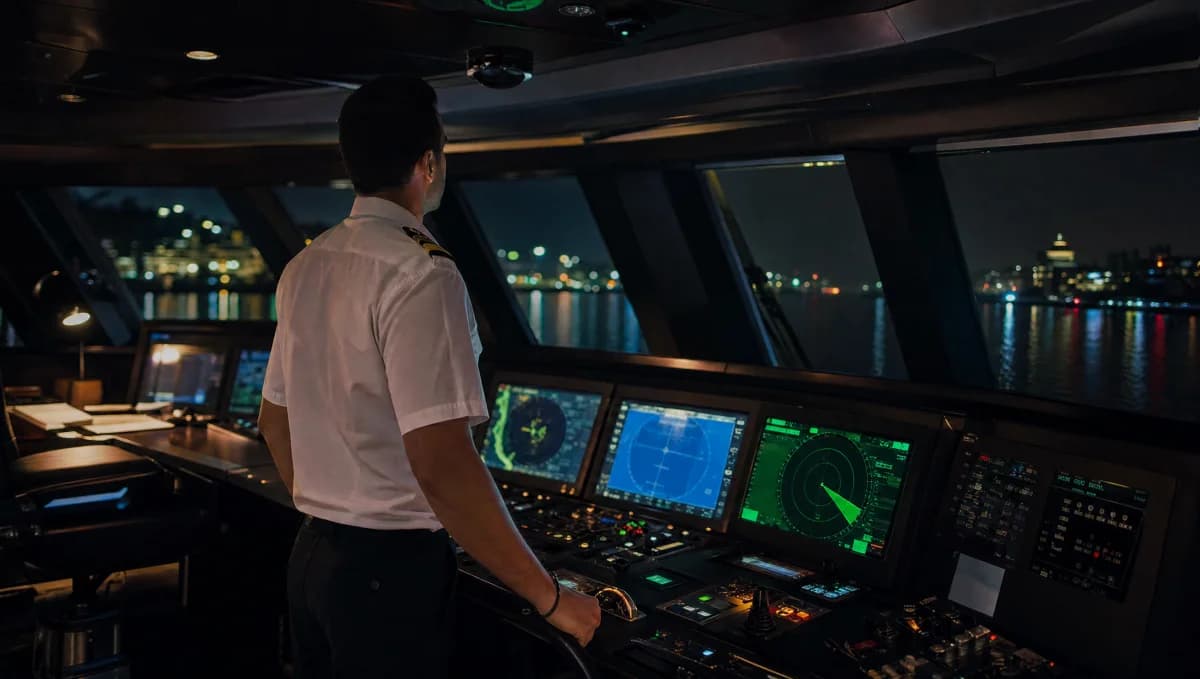
Between 2021 and 2025, Port State Control officers across three major inspection regions issued 44 citations under STCW Chapter VIII — the fitness-for-duty and rest-hours chapter. Over the same period, the same inspectors issued 1,414 citations under MLC 2006 Regulation 2.3, which governs the same underlying issue: crew working without adequate rest. That 32-to-1 gap, reported by maritime fatigue researcher Dr. Cecilia Hegamin-Younger, doesn't mean STCW rest violations are rare. It means STCW violations are hard to catch through the paperwork alone, and MLC's broader working-conditions framework is where inspectors actually find them.
For a yacht captain, that gap is the whole problem in one number. The rest-hour limits themselves are not ambiguous. What's ambiguous — and what actually determines whether an inspection goes smoothly — is whether your watch schedule and your logbook tell the same story an AIS track or an engine log would tell.
What STCW Actually Requires on Rest Hours
STCW Regulation VIII/1 requires flag administrations to establish and enforce rest periods for watchkeeping personnel and anyone with designated safety, security, or pollution-prevention duties. The operative numbers are set out in Section A-VIII/1 of the STCW Code, as amended by the 2010 Manila Amendments (in force since 1 January 2012):
- Minimum 10 hours of rest in any 24-hour period
- Minimum 77 hours of rest in any 7-day period
- Rest may be divided into no more than two periods, one of which must be at least 6 consecutive hours
- The interval between the end of one rest period and the start of the next must not exceed 14 hours
A narrow exception allows splitting the daily rest into three periods — one of at least 6 hours, two of at least 1 hour each — but only for a maximum of two 24-hour periods within any 7-day window. None of this applies during a genuine emergency; once the emergency is resolved, the affected crew member is owed compensatory rest at the earliest opportunity, not a quiet write-off.
Who Counts as "Watchkeeping Personnel" on a Yacht
STCW's fitness-for-duty chapter is narrower than "the whole crew." It applies to anyone standing a navigational or engineering watch, plus anyone with designated safety, security, or pollution-prevention responsibilities — in practice, on most yachts, that means deck officers standing bridge watches, engineers on engine room watch or on-call rotation, and any crew member formally assigned a lookout or security duty. Interior and service crew fall outside STCW's watchkeeping scope, though their working hours are still covered under MLC 2006's broader framework. Getting this distinction right matters at inspection time: a captain who logs rest hours for the whole crew under STCW when only three of them are watchkeepers is applying the wrong standard to most of the boat, while missing the specific chapter and verse an inspector will actually cite.
STCW and MLC 2006 use the same 10-hour/24-hour and 77-hour/7-day thresholds by design — they were harmonized so a compliant rest schedule satisfies both. Where they differ is scope: STCW covers watchkeeping and designated safety duty specifically, MLC covers the crew's working conditions generally, and PSC treats them as separate deficiency categories. Read the full breakdown in our MLC 2006 crew rights guide.
The Enforcement Gap: Why a "Compliant" Log Isn't the Same as a Rested Crew
The citation gap is the operational issue: signed records can look compliant while the real watch pattern is not. Captains should compare planned watches, actual work, interruptions, drills, port calls, and compensatory rest instead of treating a completed form as proof.
Source: Project HORIZON and MARTHA seafarer fatigue research, Solent University (Warsash). Survey percentages are not reproduced here; read the original reports for the figures.
None of that shows up in a logbook that's filled out to look right rather than filled out in real time.
A rest-hour record that shows textbook compliance through a period when the vessel was clearly working hard — heavy weather, a night passage, back-to-back charter turnarounds — is one of the most common triggers for closer PSC scrutiny. Inspectors cross-reference logs against AIS tracks, port timestamps, and engine room records. Discrepancies read worse than an honest deficiency with a corrective plan attached.
This is the practical argument for logging rest hours as they happen rather than reconstructing them at the end of a rotation. A watch schedule built in advance and a rest log filled in retroactively from memory are two different documents, and PSC inspectors are trained to tell them apart.
Building a Watch Schedule That Actually Holds Up
Most yachts run a two-watch or three-watch system depending on crew size and passage length. Both can comply with STCW — but only if the schedule is built around the 10/77-hour limits from the start, not adjusted after the fact when a busy leg blows through them.
| Watch system | Typical pattern | STCW risk point |
|---|---|---|
| Two-watch (6-on/6-off) | Two officers alternate 6-hour blocks | Splits rest into two 6-hour periods with no buffer — a call-out during an off-watch (arrival, engine issue) splits rest into three periods, beyond the two-period limit |
| Three-watch (4-on/8-off) | Three officers rotate 4-hour blocks | Generally the most STCW-compliant default for longer passages; easier to absorb disruptions without breaching minimums |
| Charter turnaround days | Compressed provisioning, guest changeover, departure | Highest real-world risk — non-watchkeeping duties (loading, safety briefings, admin) eat into rest windows that look protected on paper |
Build the schedule to leave margin below the legal minimum, not exactly at it. A 6-on/6-off rotation that assumes zero disruption has no room left: if a delayed guest arrival or a mechanical issue pushes back the handover at the end of both of an officer's watches by even 30 minutes, neither rest period reaches the 6 hours one of them must have.
Charter operations carry a specific structural risk here: the busiest days — turnaround, provisioning, safety drills, guest embarkation — are also the days crew are least likely to be on a clean watch rotation, which is exactly when rest hour compliance quietly slips.
Recurring mistakes worth checking for on your own vessel:
- Rest hours logged from the printed watch bill rather than what actually happened — a schedule is a plan, not a record
- A single crew member covering an absence (illness, shore leave, crew change) without anyone adjusting the rest calculation for the days they double up
- Engineers on 24-hour on-call status during passage treated as "off duty" for rest purposes even when they were called out overnight
- Rest hour logs that stop being updated the moment the vessel enters a busy charter block, then get filled in retroactively before a survey or inspection
What a PSC Inspector Actually Checks
Beyond the headline numbers, inspectors work through a fairly consistent list when rest hours come under review:
- Individual records for every watchkeeper — not a single vessel-wide summary, but one record per crew member on watchkeeping or designated safety duty
- Signed by the crew member, not filled in and signed by the officer of the watch on their behalf
- Cross-checked against the deck log, engine log, AIS track, and port arrival/departure times for internal consistency
- Retained for a minimum period in a flag state–approved format, available on request
- Patterns during known high-workload periods — night passages, heavy weather, back-to-back turnarounds — checked for suspiciously clean compliance
These checks sit inside a broader PSC inspection that increasingly treats watchkeeping fatigue and documentation gaps as part of the same risk picture. Our Port State Control guide for yacht crews covers how inspectors approach a vessel end to end, including where rest hour findings tend to surface relative to other deficiency categories.
STCW and MLC 2006: One Compliance System, Not Two Filing Cabinets
Because STCW and MLC set the same numerical thresholds, the most efficient approach on board is to run one rest-hour system that satisfies both, rather than maintaining separate STCW watchkeeping records and MLC working-hour records that can quietly drift apart. Our MLC 2006 guide covers the working-conditions side of the same requirement — Seafarer Employment Agreements, wage records, welfare standards — that sits alongside STCW's watchkeeping-specific fitness-for-duty rules.
In practice, that means: one log, one format, one crew member entering their own hours once, cross-referenced automatically against the deck log rather than reconciled by hand at month-end.
Watchkeeping at Night: Where Rest Hours and COLREGs Collide
STCW rest hour compliance and night watchkeeping competence are two sides of the same operational problem. A tired officer of the watch is a compliance failure on the rest-hour side and a collision-avoidance risk on the navigation side — the same fatigue shows up in both places. Our guide to COLREGs and yacht watchkeeping at night covers the navigational rules a fatigued watch is most likely to misjudge, from give-way obligations to lookout standards under Rule 5.
From Paper Trail to Real-Time Log
The gap between a compliant-looking record and an actually compliant crew closes when logging happens at the point of the watch, not from memory afterward. HelmOps' STCW Rest Hours Compliance Checker lets a captain or watchkeeper enter actual watch times and immediately see whether a schedule breaches the 10-hour/24-hour or 77-hour/7-day thresholds — before it becomes a PSC finding rather than after.
Frequently Asked Questions
The Bottom Line
STCW's rest hour rules are not the hard part — 10 hours in 24, 77 in 7, split no more than twice, is a schedule any competent officer can plan around. The hard part is keeping the record honest through the weeks when the vessel is actually busy, and keeping that record in a format that survives a cross-check against the AIS track and the engine log.
The enforcement gap between STCW citations and MLC citations isn't a loophole — it's a reminder that a rest-hour system built to satisfy an inspector on paper and a rest-hour system that actually protects a watchkeeping crew from fatigue are not automatically the same thing. Building the second gets you the first for free.
This guide is intended for informational purposes. STCW and MLC 2006 requirements are subject to amendment; consult your flag state administration or a qualified maritime compliance advisor for the current requirements applicable to your vessel. Sources: IMO, Seafarers' Hours of Work and Rest (imo.org); STCW Code Section A-VIII/1, 2010 Manila Amendments; UK MCA, MGN 566; ILO, Maritime Labour Convention 2006 (ilo.org); Dr. Cecilia Hegamin-Younger, "The Fatigue Blind Spot," The Maritime Executive.
What changed (7 Sep 2026): Removed or marked unsupported numeric claims and replaced them with sourceable, vessel-specific guidance.