A yacht's flag state is not a formality stamped on the stern. It sets which safety code applies at survey, which port state control regime inspects the vessel, which labour convention governs the crew's employment terms, and — indirectly — how exposed the ownership structure is to VAT and import duty questions. Owners and management companies who treat flag choice as an afterthought usually discover the cost of that decision at the worst possible moment: a failed PSC inspection, a stalled mortgage, or a charter contract that falls through because the broker's insurer won't underwrite the flag.
This guide compares the flag states that come up most often in superyacht ownership and charter decisions — Cayman Islands, Malta, Marshall Islands, and the British Red Ensign Group registries (Isle of Man, Jersey, and the British Virgin Islands) — across the dimensions that actually change how a vessel operates: registration process, tax and VAT exposure, audit and inspection regime, and crew certification recognition.
None of this is legal or tax advice. Flag state selection interacts with the owner's residency, the vessel's operating pattern, and financing terms in ways that are genuinely case-specific. Every section below is a starting point for a conversation with a flag state specialist or maritime tax advisor — not a substitute for one.
A Quick Classification Note
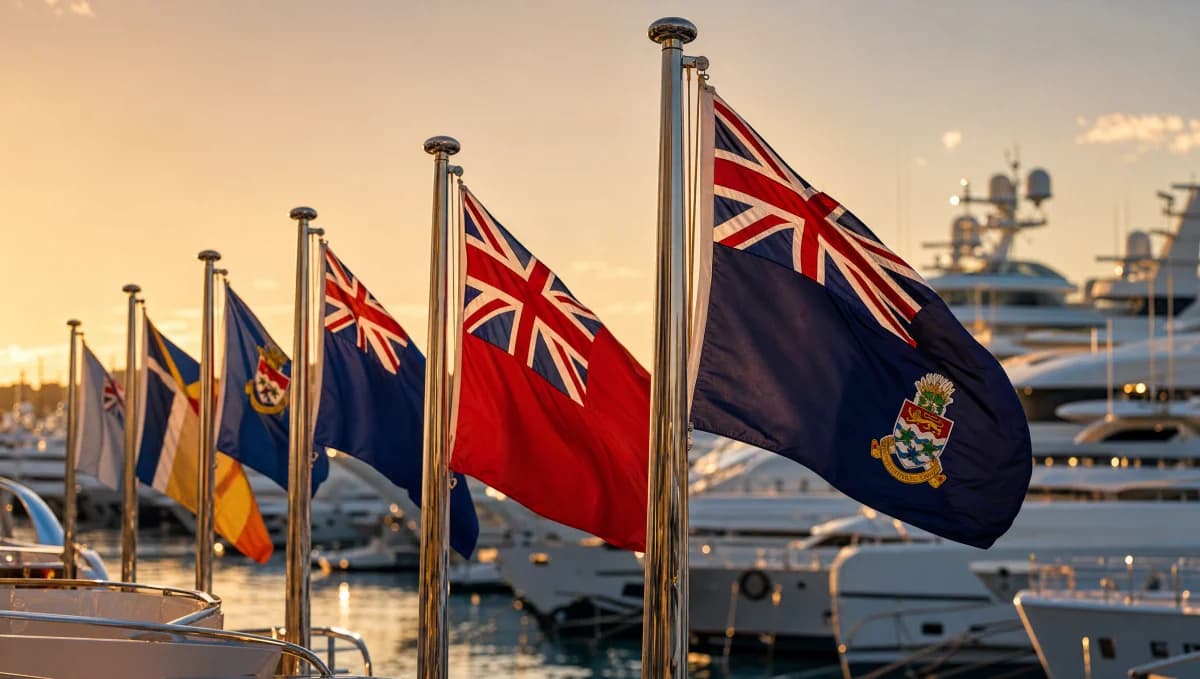
Industry conversation tends to bucket flags into "Cayman Islands," "Marshall Islands," "an EU flag like Malta," and "a Red Ensign flag" as if these are four separate categories. Technically, that's not quite right: Cayman Islands is itself a Category 1 member of the Red Ensign Group, alongside Bermuda, the British Virgin Islands, Gibraltar, Isle of Man, and the UK itself, while Jersey is a Category 2 register limited to vessels up to 150 GT (400 GT under an agreement with the UK). What owners usually mean by "the Red Ensign registries" in casual comparison is the smaller Crown Dependency and Overseas Territory flags — Isle of Man, Jersey, and BVI — that share the Red Ensign Group Yacht Code but carry a different fee structure, capacity, and specialization from Cayman. This guide follows that practical convention while keeping the technical distinction visible where it matters.
The Flag States at a Glance
| Flag State | Registry Authority | EU / VAT Position | Typical PSC Standing | Best Fit |
|---|---|---|---|---|
| Cayman Islands | Cayman Islands Shipping Registry (CISR) | No local VAT; offshore structure | Paris MOU White List | Charter and private superyachts wanting Caribbean/offshore prestige with strong technical standards |
| Malta | Transport Malta – Merchant Shipping Directorate | EU flag; VAT applies to EU-based charter and can apply to the leasing structure itself | Paris MOU White List | EU-resident owners, Mediterranean-based programs, vessels needing unrestricted EU/Schengen movement |
| Marshall Islands | MIMOSA / International Registries, Inc. | No local VAT; one of the largest registries by tonnage | Paris MOU White List | Large charter and private yachts, multi-region operators wanting global surveyor coverage |
| Isle of Man | Isle of Man Ship Registry (IOMSR) | Treated as part of the UK for VAT (20% standard rate as of October 2026); Red Ensign Group | Paris MOU White List | UHNW private ownership paired with IOM corporate/trust structuring |
| Jersey | Jersey Registry | Outside the EU; no VAT, but 5% GST as of October 2026 (Crown Dependency) | Red Ensign Group standing | British/Channel Islands owners wanting a Crown Dependency flag post-Brexit |
| British Virgin Islands | BVI Shipping Registry | No local VAT; Red Ensign Group | Red Ensign Group standing | Caribbean-based charter operations, especially paired with a BVI ownership company |
Registration Process: What Actually Differs
Every registry in this comparison requires the same core documentation: proof of ownership (builder's certificate or bill of sale, or a deletion certificate from a prior flag), evidence of insurance, and — above 24 metres or when operated commercially — a compliance survey against the applicable large yacht code. Where the registries genuinely diverge is scope and pace.
At the smaller, private end (under 24m), registration is largely paperwork-driven and fast: Isle of Man and Marshall Islands both typically process in one to three weeks. At the 24m-to-500GT commercial tier — where most charter superyachts sit — the process expands to include a Large Yacht Code (or flag-equivalent) survey, and processing stretches to three to five weeks. Above 500GT, mandatory ISM certification (Document of Compliance and Safety Management Certificate), an MLC 2006 Maritime Labour Certificate, and ISPS Code compliance all enter the picture, and full certification cycles can run six to twelve weeks or longer for gigayachts, since class society survey scheduling becomes the pacing factor rather than the flag administration itself.
A detail owners frequently underestimate: class society involvement doesn't disappear because the flag is "offshore." Cayman, Marshall Islands, Isle of Man, and BVI all delegate statutory survey authority to recognized organizations — Lloyd's Register, Bureau Veritas, DNV, RINA, and similar — for vessels above roughly 500GT. The flag sets the framework; the class society does the technical verification. This is why registration timelines at the top end depend as much on surveyor availability as on flag administration responsiveness.
For the specific requirements at each flag-and-size combination, see the Cayman Islands 24m-to-500GT registration guide, Malta 24m-to-500GT registration guide, and Marshall Islands 24m-to-500GT registration guide — or browse the full flag state directory for every combination.
Tax and VAT: Where Flag Choice Actually Bites
This is the section owners most often get wrong, usually in one of two directions: assuming an offshore flag eliminates VAT exposure entirely, or assuming an EU flag automatically triggers it.
Neither is correct. Charter VAT is generally a matter of where the charter is supplied — the EU jurisdiction the charter departs from or operates in — not which flag the vessel flies. A Marshall Islands-flagged yacht chartering out of a French port is still subject to French charter VAT treatment. Flag state affects a narrower set of questions: import/VAT-paid status of the vessel itself when it enters EU waters, and — for Malta specifically — the VAT treatment available on the ownership and leasing structure.
Malta's yacht-leasing VAT framework can treat lease use inside and outside EU waters differently, but the current rate and evidence rules must be confirmed from official guidance for the specific structure. This area has drawn scrutiny and has changed over time, which is why it should not be implemented from an older article or word-of-mouth.
Source: Malta Tax and Customs Administration, VAT guidelines (including the 12 March 2020 guidelines on the use-and-enjoyment treatment of yacht leasing).
VAT and tax rules for yacht ownership and charter change by jurisdiction and by year, and enforcement posture (particularly around AIS-based route verification) has tightened across the Mediterranean. Nothing in this article should be read as current tax guidance for a specific vessel or ownership structure — confirm the applicable rate and structuring approach with a maritime tax advisor before making a flag or leasing decision.
Offshore flags (Cayman, Marshall Islands, BVI) generally don't impose their own VAT or income tax on the vessel or its offshore-structured ownership entity; Isle of Man sits inside the UK VAT area and Jersey levies GST, so check those two separately. That neutrality is one reason the offshore flags remain popular for private ownership and for charter fleets whose operators want the flag jurisdiction itself to stay tax-neutral. But none of these flags exempt the vessel from the VAT rules of the countries where it actually charters. For the mechanics of charter VAT across the main Mediterranean jurisdictions, see our Mediterranean charter VAT guide.
Port State Control: The Regime That Actually Inspects the Boat
Flag state sets the rulebook; Port State Control (PSC) is the enforcement mechanism that boards the vessel in a foreign port and checks whether the flag's paperwork matches reality. All six flags in this comparison hold — or their group holds — Paris MOU White List status, meaning historically low detention rates relative to the fleet average. That status matters practically: White List flags face fewer targeted inspections and faster port clearance, while flags with weaker PSC records draw more scrutiny by default.
What differs between flags isn't the PSC framework itself (that's set by IMO conventions and regional MOU regimes, not by the flag), but how much technical support the flag administration provides before an inspection — pre-PSC audit programs, dedicated superyacht technical teams, and 24/7 casualty response. Marshall Islands and Isle of Man both maintain notably active pre-PSC guidance programs; smaller Red Ensign registries like Jersey and BVI lean more on shared Red Ensign Group technical standards than flag-specific tooling. For the mechanics of what PSC inspectors actually check and how to prepare, see our Port State Control yacht guide. The IMO's own overview of Port State Control is the primary international reference for how the regime works.
Crew Certification Recognition
Every flag in this comparison requires STCW certification for officers and, above the relevant crew-employment threshold, MLC 2006 compliance (a Maritime Labour Certificate backed by a Declaration of Maritime Labour Compliance). Where they differ is in how they handle certificates issued by other countries' maritime administrations.
Marshall Islands and BVI impose no nationality restriction on officers or crew — a certificate from any STCW White List country is generally accepted, subject to the usual flag endorsement process. Malta, as an EU flag, follows EU STCW recognition procedures under Regulation I/10, which non-EU officers navigate through a formal recognition application rather than automatic acceptance. Isle of Man and Jersey both apply MCA-equivalent endorsement standards, consistent with their Red Ensign Group technical alignment.
For owners and captains managing multi-nationality crews, this recognition question is often more operationally important than any tax consideration — a flag that creates friction around endorsing a chief engineer's certificate can delay a charter season start far more than a marginal VAT difference ever will. Our MLC 2006 crew guide walks through the labour convention side of this in detail.
If the vessel already has a management company or captain in place, ask which flag their current crew certificates are endorsed under before finalizing a flag decision — re-endorsing a full crew's certificates for a new flag is a real cost and timeline factor that rarely appears in flag comparison spreadsheets.
Charter vs. Private: How the Decision Actually Shakes Out
In practice, the charter-vs-private distinction drives flag choice more than any single technical factor:
- Charter-primary yachts lean toward Cayman Islands or Marshall Islands for their global brand recognition with charter brokers and insurers, or toward Malta when the charter program is EU-based and unrestricted EU/Schengen movement matters more than offshore VAT neutrality.
- Private, non-charter yachts more often land on Isle of Man, or on Jersey when the yacht is within its Category 2 tonnage limit, where the flag pairs naturally with the trust and corporate structuring services UHNW owners are already using, and where there's no charter-VAT complexity to plan around in the first place.
- Caribbean-based operations, charter or private, frequently choose BVI specifically because the operating base, the ownership company, and the flag can all sit in the same jurisdiction — reducing administrative friction rather than technical requirements.
- Vessels that might switch between private and charter use — a common pattern for owners testing the charter market — should confirm the flag supports that conversion without a full re-registration. Most of the flags above do, with a compliance survey and commercial endorsement rather than a fresh registration.
None of this replaces a conversation with a flag state agent and the vessel's management company, who will know current processing capacity, fee schedules, and any recent regulatory changes at the specific flag under consideration.
Keeping Flag State Deadlines From Becoming a Fire Drill
Whichever flag a vessel ends up under, the operational reality is the same: certificates expire, surveys come due, and crew endorsements need renewal — often on staggered schedules across different authorities. A missed ISM audit window or an expired Safety Management Certificate doesn't care which flag looked best on paper when the vessel was registered.
The Bottom Line
There is no single "best" flag state — there's a best fit for a specific vessel's ownership structure, operating pattern, and crew composition. Cayman Islands and Marshall Islands offer strong offshore neutrality and global charter-market recognition. Malta offers EU flag status that matters if the owner or the operating pattern is genuinely EU-centered. Isle of Man, Jersey, and BVI each pair flag registration with a specific corporate or operational advantage rather than competing head-on with the bigger registries on scale.
If a vessel is already flagged somewhere and the fit no longer works — ownership changed, the operating region shifted, or the tax structure needs revisiting — re-flagging is a well-understood process, not a last resort. Our superyacht re-flagging guide walks through exactly how that transition happens.
Frequently Asked Questions
This guide is intended for general informational purposes and reflects publicly available flag state and regulatory information as of mid-2026. Flag state requirements, VAT treatment, and PSC regimes change; consult a flag state specialist, maritime lawyer, or tax advisor before making registration or structuring decisions for a specific vessel.
What changed (7 Sep 2026): Removed or marked unsupported numeric claims and replaced them with sourceable, vessel-specific guidance.